Wikidpedia: an encyclopedia of Babadumb. Kool-Chewy Dynasty

Chairman Bao proclaimed the Kool-Chewy dynasty on 31st January on Meherabad Hill to tens of thousands. This announcement was met with consternation and confusion, as it was irrelevant to a sacred occasion and promoted a transparent fiction. Observers were heard to remark, “what is the Chairman chewing?” Some have maintained that this was a joke, while others have countered that if it was a joke, given the context, the Chairman should attend a remedial course in humor. By and large, the consensus is that the proclamation was not intended as a joke, but should be considered as such nonetheless, with a straight face.

Share
Posted in Wikidpedia | Comments Off on Wikidpedia: an encyclopedia of Babadumb. Kool-Chewy Dynasty

Wikidpedia: an encyclopedia of Babadumb. The Three Rings.

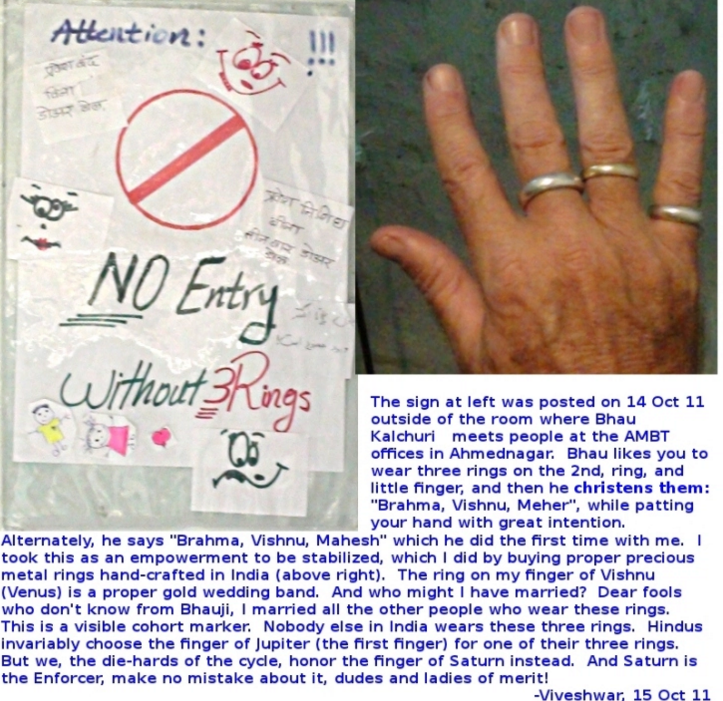
The Three Rings is perhaps the most distinguishing feature of the Jai Ho Club. The wearing of the rings represents admission into the close sahavas of Chairman Bao, and was a common practice for those who wished to cultivate a relationship with him and the Hindu gods, Brahma, Vishnu and Mahesh represented by the rings. Chairman Bao would intone their names as he would tap the respective ring on the hands of his devotees. In special cases, the wearing of the rings represents the reception of a lineage transmission, such as is the case with the second Patriarch of the Mahasiddhic Maitreya Buddha lineage, (the first Patriarch having been the Chairman himself).

Screen Shot 2016-01-04 at 6.25.58 PM


Share
Posted in Wikidpedia | Comments Off on Wikidpedia: an encyclopedia of Babadumb. The Three Rings.

Wikidpedia: an encyclopedia of Babadumb. Chairman Bao

Chairman Bao was a junior Mandali who in late life procured  The Three Rings of power. This had unforeseen consequences. His borrowed charisma resulted in a vast retinue which in time came to be known as the Jai Ho Club. Chairman Bao possessed an extraordinary talent for equivocation which conferred a political genius not even dementia could defeat. However, the Kool-Chewy dynasty of which he was the contrived scion, came to naught.

Share
Posted in Wikidpedia | Comments Off on Wikidpedia: an encyclopedia of Babadumb. Chairman Bao

Wikidpedia: an encyclopedia of Babadumb. Innaugral entry: Jai Ho Club

The Jai Ho Club was a latter-day inspiration of Chairman Bao. This fan club represented Bao’s inner circle  of Mothers, Queens, caregivers, attendants, secretaries, bodyguards, close fans and, it must be admitted, the occasional sycophant. Select members were given special names and functions, like Queen of Dunny. Jai Ho members were enjoined to wear The Three Ringsrepresentative of the Hindu Trinity, Brahma, Vishnu and Mahesh, which names Bao would intone as he tapped the respective ring. The Jai Ho Club was essentially a spiritual glee club with special, rather unpronounceable mantras like Jai Ho Her Her Ko Ko Her Ko Her Ho Ho Ho, whose meaning remains elusive. For those who could not master the advanced mantras, the seed syllable mantra of Jai Ho was utilized. The Jai Ho Club included other, subsidiary clubs like the Jai Ho Dance Club, and the Jai Ho Internet Chat Club. The Jai Ho Club largely disbanded upon the passing of Chairman Bao and the end of the Kool-Chewy dynasty.

Share
Posted in Wikidpedia | 8 Comments

Ghazal #96 from Ghazals For The Friend

I run from the rotting stench of my precious thought,
But cannot find the pure, sweet breeze of I am not!

The sweet grace of Lord and Master will set me free,
When I submit myself to grace and cease to be.

For now, God help us to learn the high circus arts,
Like how to make a lion laugh and a monkey fart!

Perhaps, the Master will be inclined to believe,
We are useful to his pleasure and deserve reprieve.

We hang out around his court by all contrived means,
(And never with complaint about the refried beans.)

We understand no man has ever petitioned love
Except at beauty’s feet, with the Beloved tall above!

There are few things about which Darvish has no clue:
The most regrettable is how to his foul mind eschew!

Share
Posted in english language ghazals | Comments Off on Ghazal #96 from Ghazals For The Friend

Bio of Francis Brabazon from “Stay With God”

Francis Brabazon – A Biographical Sketch
Francis Brabazon was born in England in 1907. He moved to Australia with
his family when he was a young child, the youngest of five children.
They settled on a farm in Victoria. In his book THE WIND OF THE
WORD he describes these early days. He was close to his father who had
been a drama critic and through him became interested in literature. By
his early teens he became disillusioned with his Anglican faith because
of the lack of answers to his questions.
In the early 1930s in Melbourne, in the midst of the Depression, he worked
at odd jobs and educated himself, learned to play the piano and achieved
an unofficial Australian record at weightlifting. Francis met the Baron
von Frankenburg, a Sufi teacher from the school of Hazrat Inayat Khan.
Many of the Baron’s group later became followers of the Spiritual Master
Meher Baba. Francis began to paint, was drafted into the army early in the
war but did not fit into the military life – too many questions again.
An exhibition of his paintings in Melbourne during this period
influenced the fledgling Antipodean Movement in Australian painting and
especially the early work of one of Australia’s greatest artists, Sidney Nolan.
Brabazon turned to poetry and was published in the controversial Angry
Penguins Magazine and Ern Malley’s Journal until his poetry became
mystical and from then until his death was ignored by the various
literary movements in Australia, except for the young La Mama poets of
the late sixties. His first published books PROLETARIANS –
TRANSITION and EARLY POEMS were written during the 1940s.
In 1947 the Baron gave Francis the DISCOURSES of Meher Baba. Meher
Baba stated that he was the Avatar, the Christ, God in human form. Francis
was extremely interested. The Baron died in 1950 and in 1952 Brabazon
travelled to the USA and met Meher Baba, who made a profound
impression upon him. In 1954 Meher Baba called Brabazon to India where
they travelled to Andhra Pardesh. JOURNEY WITH GOD published in the
same year describes this experience. SEVEN STARS TO MORNING, his
first major book of poems was published in 1956, the year of Meher Baba’s
first visit to Australia. Country Life said of it: ” . . . covers the planet in a
riot of intellectual experience . . . sincerity and much dignity.” This was
followed by publication of a long narrative poem CANTOS OF
WANDERING in 1957 and a book of seven mystical plays SINGING
THRESHOLD in 1958. In the same year Meher Baba visited Australia
again and stayed at a place in Woombye, Queensland, that Francis and
other followers had built for him. This was to become known as Avatar’s
Abode.Subsequent to this visit Meher Baba invited Francis to India again where he
stayed with him as an intimate disciple for the following ten years until
Meher Baba dropped his physical form in 1969. When Brabazon went to
India he took with him the almost complete manuscript of STAY WITH
GOD which Meher Baba had asked him to write. Francis says in the preface
to a later work THE WORD AT WORLD’S END: ” . . . I have infinitely
crafted my ideas before beginning to write; and in my best work the idea
forged its own form of expression. In STAY WITH GOD the opening line
came to me twelve years before I wrote that book. And it was not an odd
line jotted down and forgotten; I carried it with me, noting its
possibilities and acquiring the material it would need.” Meher Baba had
the book read to him three times stating that it gave life to his own book
GOD SPEAKS and said: “My love will touch the hearts of all who read it as
no book has ever done.”
STAY WITH GOD (1959) is a lucid exposition of the Advent on earth, in
our time, of the God-Man and of this living embodiment of Godhood as the
Salvation of Mankind from its state of permanent anxiety and threatened
annihilation. This God-Man is not seen as the Son of a Father, but as
the very Self of each one of us and therefore, easily knowable to
anyone directly, without an intermediary. In the creative process of
perceiving the meaning of the God-Man, the author examines the values of
Mankind, both Eastern and Western, past and present, as represented in
Art and Literature. His language, arising directly from the urgency of his
message and the clarity of his vision, avoids rigid crystallizations, by
which modern poetry is immobilized and essence and vitality excluded.
Upon return to Australia THE WORD AT WORLD’S END (1971) was
published, then IN DUST I SING (1974), a collection of poems written at
the insistence of Meher Baba. These poems were based on the form of the
‘ghazal’ – perfected by the Persian poet Hafiz of Shiraz (1320-1390): Meher
Baba’s favourite form of poetry. Another collection of Brabazon’s
‘ghazals’, THE BELOVED IS ALL IN ALL, were published
posthumously in 1988. Other published works of Francis Brabazon include
LET US THE PEOPLE SING (1962) songs, THE EAST-WEST
GATHERING (1963), THREE TALKS (1969), WIND OF THE WORLD
(1976), THE SILENT WORD (1978) a biography of the early life of
Meher Baba and THE GOLDEN BOOK OF PRAISE (1982), songs. Some
of his writing remains unedited and unpublished. Francis Brabazon died in
1984. His grave is at Avatar’s Abode on the side of the hill, under the pine
trees, overlooking the ocean.

Share
Posted in articles and notes | Comments Off on Bio of Francis Brabazon from “Stay With God”

Ayatollah Queen

God help us, God save us, from the Ayatollah Queen:
may we never parade before the mirror and preen.
May we never pump our spirit with precious fatwa,
and pass our droll days preaching on the latrine.

Share
Posted in quatrains | Comments Off on Ayatollah Queen

Big Fist and the gods of doublethink command our praise

Big Fist and the gods of doublethink command our praise;
we have become devoted to flag waving all our days.

The corporation now wears a crown as a religious right,
with the grasping public gasping with spiritual malaise.

How did we come to live upside down in a garbage can;
how come to cherish trash as treasure in such a daze?

Shock and Awe has so concussed us with patriotism,
we drool our anthem in the smoky brain’s dull haze.

Long live the divine king of blind and naked aggression;
long live the royal greed of Democracy’s cannon blaze!

Darvish, as the fireworks of misbegotten zeal explode,
the Silence of love prepares to break and bless our ways.

Yes, the wrath of God Man’s Silence will soon break the spell
of the noise of doublethink, and mend and bless our ways.


Share
Posted in english language ghazals | Comments Off on Big Fist and the gods of doublethink command our praise

How Ladinsky and Penguin have misrepresented and betrayed Hafiz/ Hafez

Ladinsky’s several books of poetry published by Penguin falsely claim to be either translations, versions or renderings of the poet Hafez; in fact, they are not based on the Persian text nor are they based on existing English translations or versions.

This literary misrepresentation was first perpetrated by Penguin fifteen years ago with the publication of The Gift. Three other volumes have since followed.  This relentless misrepresentation of the greatest poet in the thousand year tradition of Persian poetry is breathtaking.

Poetry for Persian speakers is not a pastime. It’s not like watching TV or having a barbecue. There is perhaps no poetic tradition in the world that holds the same intellectual, aesthetic and spiritual importance for its speakers than is the case with Persian poetry.

There are many, many great Persian poets. To appropriate the name of the greatest among them and make his work sound downright silly and trite- but promote it to the world as genius, is truly remarkable and, in the eyes of Persians, unforgivable. It is much worse than an instance of cultural theft; it’s more like an extraordinary rendition in which torture effects a lobotomy, and with the abductee then propped up before the cameras for the nightly news.

Persians have come to realize that America simply does not have a learning curve about the Middle East in general and Iran in particular. The 1953 CIA coup against the first democratically elected leader of Iran and his replacement with the despotic Shah has set the tone for an antagonistic relationship with this country. The ongoing sanctions against Iran have succeeded marvelously in punishing Persians for their legitimate national aspiration of producing nuclear reactor fuel. And now, Penguin’s best selling Hafez in English translation is spouting New Age inanities as medieval Persian spiritual truths.

Ladinsky is a pile of contradictions: he has variously claimed that his work is either translation, version or rendering on the one hand, and that his work channels the Spirit of Hafez on the other hand. But there is no textual relationship to the Divan-e-Hafez in Persian or to English translation in either case.  He has not been able to account for why his work deserves to be considered anything other than his very own pretentious verse. He has wrapped his tragic literary success in his relationship with his spiritual master, Avatar Meher Baba, for whom honesty was paramount and whose favorite poet was Hafez because of the beauty and veracity of his verse; yet, at the same time, he can not properly identify his literary efforts as nothing but products of his own imagination. How sad.

But what about Penguin? They have no end of editors whose job it is to check the integrity of manuscripts submitted for publication. This is not only sad, this is fraud!


Share
Posted in articles and notes, reviews, ripostes | 1 Comment

Ladinsky’s Ersatz Hafez

Translation is complicated in that the veracity of the work must be taken on faith if one does not know the original language. Thus good translators are careful to account for their approach to the craft and take seriously the need to educate their readership. This is especially the case with languages and traditions that are removed from European cultural experience and when translated for an English speaking public which is often monolingual.

Unfortunately, such is not the case with the several publications of Daniel Ladinsky that variously purport to be either translations or versions of the great and inimitable Hafez of Shiraz. Hafez is treasured by Persian speakers as the greatest poet of what is perhaps the world’s greatest poetic tradition. To misrepresent him so blatantly, thoroughly and consistently over time as Ladinsky has done, is breathtaking. His work in “translation” does not represent the ghazal form, is not based on the Persian text and can not be referred to existing English translations and versions.

The ghazal in Persian commonly has anywhere from seven to fourteen couplets with an aa, ba, ca, da etc rhyme scheme. The poet “signs” his ghazal with a pen name.  Each Persian line in English translation has, on average, about fourteen syllables. The following is my translation of a Hafezian ghazal to illustrate structure, rhyme and typical themes:

Ghazal #332, Khanlari

Although I seethe like a vat of wine from love’s ferment,
I drink blood with sealed lips that keep me silent.

It is the soul’s resolve to possess the beloved’s lips;
Look at me, whose struggle with soul has left me spent!

How can I be free from heart’s sorrow when each breath
The idol’s black curl rings my ear with the slave’s ornament.

God forbid that I fall in love with my own devotion;
This much is true: I drink a glass when the time is cogent.

I hope that on Judgement Day upon the enemy’s note,
The burden of His grace doesn’t leave me twisted and bent.

My father sold the green of heaven for two grains of wheat;
Why not sell for less this garden that blooms but a moment?

My wearing the dervish frock is not about religion;
It is a covering to conceal a hundred torments.

I who wish to drink only pure and filtered wine, what can
I do but remain with the wise Magian conversant?

If in this way our minstrel plays in the mode of love,
Hafez’s verse when heard will create astonishment.


The ghazal is a song composed of couplets which tells a story, one not based on linear narrative but rather on deeply associated themes. The most consistent theme in Hafez’s ghazals is the religion of love.

Ladinsky’s work on Hafez does not remotely resemble the ghazal in its Persian line arrangement, as illustrated above. Now, his work need not necessarily mirror the formal qualities of the Persian ghazal in order to convey the meaning and spirit of a given ghazal. However, the problem is much worse than that of form. Ladinsky does not work from the Persian but has claimed to work from various English translations, notably Wilberforce Clark’s literal, stilted, Victorian era crib of the Divan-e-Hafez. But since he does not “translate” whole ghazals, but fragments of ghazals, and does not identify what material is the basis for a given “translation/ version”, it is impossible to establish even an abstract connection with any text at all. When I read Ladinsky’s work, I am not reminded of Hafez in the slightest, and I have translated some eighty Hafez ghazals from the Persian. There is not even a faint echo of Hafez in Ladinsky’s work.

So where do Ladinsky’s “celebrated” translations come from? Fortunately, Ladinsky has himself supplied the answer. He has been compelled to explain, without the slightest hint of self contradiction or embarrassment, that what he refers to as translation and version is in fact the result of channeling, ie Hafez came to him in some kind of vision and supplied him with the spiritual and linguistic essence of his work.

This being the explanation that Ladinsky has supplied to account for his literary modus operandi, why did he and his publisher not publish his work as New Age spiritual transmission, or the like?

It is abundantly clear that the answer has more to do with marketing and sales than a gift for honest representation.


Share
Posted in articles and notes, reviews, ripostes | 1 Comment